Sunday, September 22, 2013
Fusion co-existence session - OOW 2013
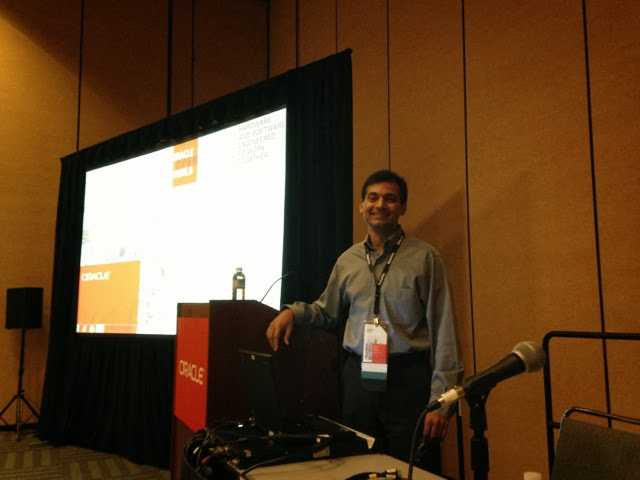
Successfully completed delivering my session on Fusion co-existence. Energetic discussion on options for migration and what would be the right roadmap.


OOW 2013 - lines at 7:30am
This is the line for registration at 7:30am... ON SUNDAY ! And the weather outside is 72 and sunny
OOW 2013 - it's all about the cloud
This year seems to be all about the cloud. Last years emphasis on hardware appears to have waned. 

The sub theme is platform with a focus on applications.
Sunday, September 30, 2012


Thursday, June 7, 2012
Oracle Announces Cloud Offering
Larry
Ellison announced the official release of the Oracle Cloud on Wednesday (6/6/2012).
The highlights of his announcement were:
CRM to SRM:
Oracle
is looking to extend the definition of Customer Relationship Management (CRM)
to Social Relationship Management (SRM).
Conceptually this implies looking beyond existing customers, to potential customers. Oracle’s
cloud platform provides hooks to Facebook / Twitter / LinkedIn to facilitate
this approach.
Cloud Infrastructure Services:
Oracle
announced its own Public Cloud. The infrastructure supporting this Cloud
(Security / Monitoring / etc…) is provided as a set of cloud services. The
implication is that these services can be used as infrastructure components to
build out cloud based applications.
HTML 5:
Oracle
cloud based applications (including Fusion Applications) are HTML 5 compliant.
The implication is that they are implicitly mobile-aware. The applications can
run on iPhone / iPad / Android without additional development
PaaS:
Oracle’s
cloud includes Platform as a Service in two areas – Database and J2EE
containers. The implication is that Database “services” can now be provided
on-tap. Also Java applications can be deployed without requiring a parent Java
container to host them.
My key
takeaways were:
- Applications can be moved TO Oracle public cloud, and moved BACK on-premise. There is no vendor lock-in.
- Oracle Cloud Applications (including Fusion) are NOT multi-tenant. Each organization has its own virtual machine and its own data store. Important when it comes to data insulation concerns.
- Upgrades to applications hosted on Oracle public cloud are NOT mandated. Clients can choose when they would like to upgrade, based on their business cycles.
There
was the usual bashing of competitors:
SAP – SAP’s 2020 launch of Cloud based applications for their
SAP suite was ridiculed. The acquisition of SuccessFactors was portrayed as a
way to buy into the cloud arena
Salesforce.com -
Forced upgrades and multi-tenant model was portrayed as a raw deal to
clients
Workday – Their Flash based UI and
object-oriented data model was portrayed as a non-starter. The fact that they
do not have HTML 5 support was seen as an architecturally colossal mistake
Mark
Hurd announced Oracle Platinum Services.
This is a premium support service for Exadata / Exalogic / Exalytics /
SuperCluster.
Friday, June 3, 2011
Oracle's affair with ExaLove

If anyone is following the press around Oracle, it is hard to miss Oracle’s infatuation with Exa. It started with ExaData, the database machine that was so fast it supposedly improved the collective productivity of the human race by 300%. (Of course, these claims are still waiting to be independently validated by IBM).
I had the opportunity to evaluate Exalogic (at close range) recently and I think I am starting to understand the reason behind this excitement. It is not Exadata or Exalogic alone that has got the Oracle Universe a-buzz, it is the possibilities that Exa brings to the IT and business landscape.
I anticipate that post-Exalogic, Oracle will start coming up with a whole host of pre-built appliances that are specialized for a niche area (think data warehouse appliance, BI appliance, sector-specific appliance) while continuing to provide an as-you-want platform in Exalogic.
I can see where the infatuation for “Exa” comes from, and look forward to seeing the vision materialize.
I can see where the infatuation for “Exa” comes from, and look forward to seeing the vision materialize.
Wednesday, March 16, 2011
Manufacturing Clouds - 3D Printing
 A recent article in the technology section of the economist discussed advances in 3D printing. This technology allows users to literally print out objects of everyday use. This “additive” approach to manufacturing as opposed to the traditional approach which is “subtractive” in nature, allows for much more economy in terms of use of raw material. It is also highly custom as each print run can be unique. The cost for each item is limited to the raw material (titanium powder, synthetic plastic, etc…) required for that build. An entire production line does not need to be designed (or modified) for each item that is built.
When I read this article, it sounded eerily familiar. Traditional IT approaches require a long lead time in terms of design, development, change management and deployment to bring a new application to life. The ultimate purpose of the application is to provide business functionality. If it were possible to build low cost prototypes, or even better, build and retire functionality it would be equivalent to the “additive manufacturing” phenomenon in manufacturing.
Of course, in IT we have the cloud based approach to pay-per-use infrastructure (IaaS). We have pay-per-use functionality in terms of hosted applications (SaaS). We also have pay-per-use platforms for hosting complex applications (PaaS). In this context manufacturing appears to have found its own “Cloud” and the advantages stemming from this change will be nothing short of world changing.
Sunday, March 6, 2011
There is no “Cloud” in Cloud Computing
Last year Larry Ellison (Oracle CEO) had an outburst about the entire buzz regarding “the cloud”. He was amused with the cloud being seen as a new technology that was going to change the world of IT as we see it. One year later, his comments that Cloud is not a new technology, simply a new business model for delivering more of the same continue to hold true. This 3 minute video is worth watching from the 2:15 mark onwards.
In my discussions with business (not IT) leaders, the cloud continues to be seen as a new technology that eliminates in-house IT. The fact that cloud computing is a new model of delivery, NOT a new technology is overlooked. Although, cloud has many advantages the fundamental fact that it is a new way of doing more of the same needs to be repeatedly communicated. Cloud is a business enabler, not a business changing proposition. New revenue channels will need to be based on innovative ideas, simply moving to the cloud is not going to bring new business.
Friday, January 28, 2011
Resurgence of Enterprise Architecture
The current IT landscape has several new emerging trends and technologies. Many of these have progressed beyond the hype-cycle and have moved into implementation mode. In the near-term the following technologies are playing out within the business/technology realm. A detailed map of these emerging technology areas and corresponding technology clusters is provided in Capgemini’s TechnoVision.

All of these technologies provide valuable solutions to current business issues. However, these benefits are multiplied when they are used in conjunction with each other. For example: Using a SaaS based approach for managing Sales is good (Think SalesForce.com). However, if the Sales functions were integrated with the back-end Financial systems in real-time using a SOA based approach; it would provide for much deeper insight in terms of forecasting and budgeting.
The expertise in stitching together new technologies meaningfully has always been a challenge. Enterprise Architects (EA) have been responsible for serving as the bridge between IT and business. Translating business strategy into applications and IT functions that meet those goals. With this new array of emerging technology, and the high-level of overlap between different technology areas, the role of the EA has become even more vital to an organization. The Enterprise Architect role has now extended from not only being the business-IT bridge, but also being the thought leader for an organization. The EA is now responsible for evaluating technology trends and incorporating the right mix of emerging technologies to meet strategic goals. The “mixing” part of an EA’s responsibility is something that has fundamentally changed.
Tuesday, December 28, 2010
SOA Composite for the New Year
For those of us who think in terms of "components", the SOA composite below sums up good wishes for the new year. Wishing you a fabulous 2011.
 |
Saturday, December 11, 2010
History repeats itself... internet to cloud
When the internet moved beyond the hotmail phenomenon and become a serious contender in enterprise computing; there was the usual media hype about end of IT departments and the imminent move to internet based services. After almost two decades of enterprise grade internet applications, IT departments continue to run certain sets of applications while some applications have moved to the internet.
The value of in-house IT to maintain and run vital business processes was apparent with core applications being maintained in-house. These core applications moved from a client-server to an internet delivery model, but the "network computer" (although a great concept) never really took off. At the same time, internet based functionality provided a completely new level of access to applications, and created entirely new models of business and gave rise to yet unseen businesses (Ex: Webex)
Ultimately the internet was embraced by the enterprise where an appropriate blend of "intranet" and "internet" functions continue to co-exist.
In the cloud arena, similar hype is currently being played out. The end of enterprise IT is trumpeted by popular channels, with an "Everything-as-a-Service" model being proposed as the end-game. These propositions are similar to what the internet went through, and if history holds true, we will eventually end up with a hybrid mix of private and public cloud models of delivery.
The public cloud clearly has value as long as it not used as simply a cost-cutting mechanism. The private cloud would host the enterprise jewels, which would be too precious to host in a public space.
The value of in-house IT to maintain and run vital business processes was apparent with core applications being maintained in-house. These core applications moved from a client-server to an internet delivery model, but the "network computer" (although a great concept) never really took off. At the same time, internet based functionality provided a completely new level of access to applications, and created entirely new models of business and gave rise to yet unseen businesses (Ex: Webex)
Ultimately the internet was embraced by the enterprise where an appropriate blend of "intranet" and "internet" functions continue to co-exist.
In the cloud arena, similar hype is currently being played out. The end of enterprise IT is trumpeted by popular channels, with an "Everything-as-a-Service" model being proposed as the end-game. These propositions are similar to what the internet went through, and if history holds true, we will eventually end up with a hybrid mix of private and public cloud models of delivery.
The public cloud clearly has value as long as it not used as simply a cost-cutting mechanism. The private cloud would host the enterprise jewels, which would be too precious to host in a public space.
Thursday, December 2, 2010
Fusion Middleware design patterns
With the recent release of Oracle FMW 11g, the perception of the product has moved from being a "good" integration platform to being a robust application development platform. A recent book that caught my attention was Oracle FMW Patterns by Harish Gaur / Markus Zirn.
 The book is based on 10 use cases and provides interesting guidelines on FMW patterns. Will provide more feedback once I have had a chance to read it cover-to-cover.
Monday, November 22, 2010
Business value from the cloud – Process Machines
Using the cloud as a Utility service has advantages. It enables computing on a pay-as-you-go-model. However, the advantages of Infrastructure/Platform are highly relevant to IT departments. From a business perspective this is still same old IT. The underlying delivery model may be different and the pricing may be attractive, but it does not bring any meaningful value to business operations, besides optimizing IT functions.
To make the Cloud relevant to the business, the pay-as-you go paradigm needs to be extended to business functionality. What if … business functionality could be enabled "on tap". A business function that currently needs to be designed and developed by the in-house IT team could instead be leveraged on-demand by a hosted provider of functionality.
In this scenario, the cloud becomes much more tangible to the business, as it provides the ability to enhance existing business processes, and use these enhancements on as as-needed basis. Of course, this concept applies equally to both private and public cloud environments. The granularity of the business function needs to be defined, but several industry examples are available:
- Calculations based on federal standards that change regularly (Ex: FDA mandated formulae for calculating sugar content)
- Widget functions that are regularly used (Ex: Geo mapping capability)
- Complex but static business functions (Ex: Tax filing)

Own / Lease / Taxi … Zip Car
Defining the utility computing model and explaining various layers and types of clouds has been an industry staple for a while. Attempts to define the cloud have been many, and they have been memorialized in the NIST definition as reproduced below:
Cloud computing is a model for enabling convenient, on-demand network access to a shared pool of configurable computing resources (e.g., networks, servers, storage, applications, and services) that can be rapidly provisioned and released with minimal management effort or service provider interaction. This cloud model promotes availability and is composed of five essential characteristics, three service models, and four deployment models. |
A conceptual model for the cloud layers is as follows:


| We start with the traditional ownership model where you outright purchase a car. You own the vehicle, and can choose the color, the trim and the accessories. The car costs you the same whether you keep it in the garage or drive it 12 hours a day. You are also responsible for the maintenance and insurance for the vehicle. This is the on-premise model for traditional software, where-in you own the software, can modify it as you please and are also responsible for the maintenance of the software. |
 This model reduces the amount of ownership you have for the software, but it also lowers the maintenance overhead. As a business you start leveraging the software for the business function it offers without having to get overly involved in the maintenance of the application. |
 Granular pieces of functionality are leveraged on demand, and you pay for what you use. This is a highly efficient model for leveraging specific business functionality. There is no ownership and no maintenance overhead. Also you get what is delivered, and have no control over the structure of the services, and have to adapt your business processes to accommodate these services. |
What if…. You liked the on-demand model of the cloud, the pay-as-you go convenience of the cloud, but still wanted the ability to customize your experience. Essentially you wanted a taxi, BUT wanted to choose the model of the taxi… AND you wanted to drive it. You wanted all of this for short periods of time and did not want to have any of the liabilities that come with ownership. This is possible, and in the "car" analogy is provided by the Zip car providers in major metro cities. This confluence of pay-as-you-go with the flexibility of limited ownership is provided by layering a SOA based approach in a cloud environment. This approach provides for a pre-built process on the cloud that can be further orchestrated to work with existing business processes. |
Wednesday, February 17, 2010
Mental Note - Cloud Examples
Type | Acronym | Example |
Infrastructure as a Service | IaaS | Amazon - EC2 |
Platform as a Service | PaaS | Salesforce - Force.com |
Software as a Service | SaaS | Google – Google Apps |
Credit: Aaron Levie – CEO Box.net (link)
Tuesday, February 16, 2010
SOA Governance and AmberPoint
The tools and skill sets required in designing a SOA based system, are quite different from maintaining the same system once it is operational. This is different from traditional systems where the skills and tools to develop and maintain an application remain the same.
A SOA based system interacts with multiple applications and crosses multiple middle ware platforms. Tracing a transaction from source to destination is complicated. It is especially opaque when a transaction does not complete, and it needs to be traced to the point of failure.
Embedding "hooks" within the SOA code to help troubleshoot transactions is one approach, albeit expensive in terms of coding and maintenance. Several error handling frameworks have been developed to overcome this fundamental complexity of a SOA-based system.
Oracle's acquisition of AmberPoint is a good step forward in providing a comprehensive tool based approach to SOA Governance. It would be ideal if the tool is left as a stand-alone option without getting embedded into the Oracle Enterprise Manager product suite. A good UI with a solid set of well documented API's would go a long way in reducing the maintenance overhead if an operational SOA system.
A SOA based system interacts with multiple applications and crosses multiple middle ware platforms. Tracing a transaction from source to destination is complicated. It is especially opaque when a transaction does not complete, and it needs to be traced to the point of failure.
Embedding "hooks" within the SOA code to help troubleshoot transactions is one approach, albeit expensive in terms of coding and maintenance. Several error handling frameworks have been developed to overcome this fundamental complexity of a SOA-based system.
Oracle's acquisition of AmberPoint is a good step forward in providing a comprehensive tool based approach to SOA Governance. It would be ideal if the tool is left as a stand-alone option without getting embedded into the Oracle Enterprise Manager product suite. A good UI with a solid set of well documented API's would go a long way in reducing the maintenance overhead if an operational SOA system.
Alliances in the Cloud
The cloud based approach necessitates a partnered approach.It is difficult for a single provider to have the breadth and depth of expertise across all cloud layers (infrastructure / software / functionality) to provide a meaningful service offering.
The 2 teaming agreements in the last couple of days highlights this approach:
Fujitsu + Canon - Provides a cloud based print offering.
Fujitsu + MindTouch - Provides a cloud based scanning solution
The rapid pace at which service providers are partnering to provide best-of-breed offering adds credence to the value that cloud computing provides.
Wednesday, January 13, 2010
Why Larry hates the term "cloud"
Larry Ellison is hilarious in this clip from his address to the Churchill Club. The key take away is the comment: "Our industry is so bizarre, they change a term and they think they have invented technology."
In Larry's opinion network computing is back and now instead of being called "SaaS" or "On Demand", it is called cloud.
In Larry's opinion network computing is back and now instead of being called "SaaS" or "On Demand", it is called cloud.
Thursday, December 24, 2009
Fusion Applications - Concerns related to IP
MB Technologies makes Bindows, a toolkit which provides a windows look and feel. This was licensed by Hyperion prior to its acquisition by Oracle. There appears to be a dispute in terms of licensing agreements between Oracle and MB Technologies, as Oracle is using this technology as a part of Fusion Applications.
This indicates that parts of Fusion Applications will have a windows look and feel. It also may point to potential future issues with licensing terms with OEM's whose products have been implicitly licensed prior to being acquired by Oracle.
Source Link: Oracle Slapped With Suit Tied to Fusion Applications - PCWorld Business Center by Chris Kanarcus.
Posted using ShareThis
This indicates that parts of Fusion Applications will have a windows look and feel. It also may point to potential future issues with licensing terms with OEM's whose products have been implicitly licensed prior to being acquired by Oracle.
Source Link: Oracle Slapped With Suit Tied to Fusion Applications - PCWorld Business Center by Chris Kanarcus.
Posted using ShareThis
Thursday, December 3, 2009
Cloud Computing vs. SaaS
At first blush cloud computing does not seem to be different from Software as a Service (SaaS). Both provide hosted capability and a pay-per-use model. The following 1 minute video rPath demystifies a bunch of terms related to cloud computing, including "grid computing", "platform as a service" and "utility computing".
The analogy of a fully-owned car (On-premise), a leased car (SaaS) and a Taxi (Clod Computing) is helpful, and is explained well in the following video, courtesy of GoGrid.
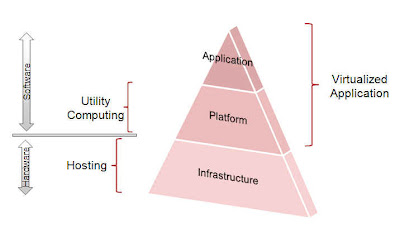
While the definition of cloud computing continues to evolve, in essence you could use Cloud computing in 3 ways:
The analogy of a fully-owned car (On-premise), a leased car (SaaS) and a Taxi (Clod Computing) is helpful, and is explained well in the following video, courtesy of GoGrid.
While the definition of cloud computing continues to evolve, in essence you could use Cloud computing in 3 ways:
- Infrastructure as a Service - Think disk space, similar to Amazon's EC2.
- Platform as a Service - This is the evolving space. Here you have a server+Infrastructure available as a service.
- Application as a Service - Think Salesforce.com, however this is pay-per use, NOT pay-per-user.
The following diagrams illustrate this concept:

The ability to "plug-in" and pay-per-use of IT capability is ultimately quite compelling.
Subscribe to:
Posts (Atom)